
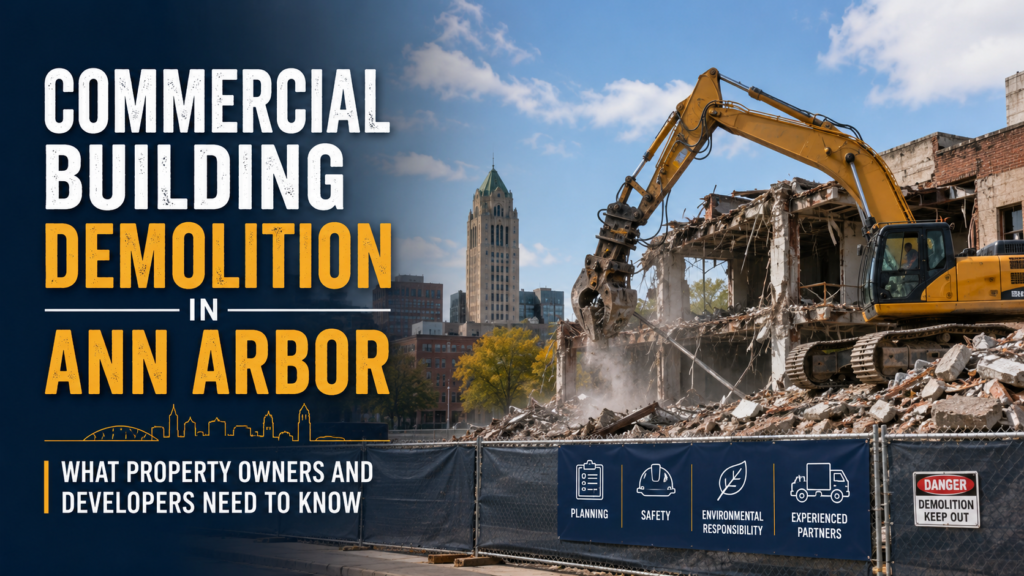
Ann Arbor is a city in constant evolution. Its downtown core, University of Michigan campus adjacencies, and expanding commercial corridors have generated ongoing cycles of construction and redevelopment for decades. Office buildings are repurposed. Strip malls make way for mixed-use developments. Industrial facilities are cleared for new residential communities. At the center of every one of these transitions is commercial building demolition, a specialized discipline that demands far more than brute force and heavy equipment.
Commercial Building Demolition Ann Arbor involves structural engineering assessments, hazardous material identification and abatement, permit acquisition through the City of Ann Arbor’s Planning and Development Department, coordination with utility providers, and the careful management of debris from a variety of building materials. Understanding what this process entails and why it requires qualified, experienced professionals is essential for any property owner or developer planning a commercial redevelopment project in Washtenaw County.
What Is Commercial Building Demolition?
Commercial building demolition refers to the controlled removal of structures that were built and used for non-residential purposes: office buildings, retail centers, hotels, restaurants, warehouses, industrial facilities, parking structures, medical offices, and similar properties. While the end goal clearing a site for new development may seem simple, the process of achieving it safely and legally is significantly more complex than residential demolition.
Commercial structures typically involve larger footprints, multi-story construction, heavier structural systems (including steel frames, post-tensioned concrete, and tilt-wall panels), more complex mechanical and electrical infrastructure, and a higher probability of containing regulated materials such as asbestos, lead-based paint, polychlorinated biphenyls (PCBs), and other substances governed by federal and state environmental regulations. Each of these factors demands specific expertise and planning before a single wall comes down.
Types of Commercial Demolition
Total Structure Demolition is the complete removal of a commercial building and, in most cases, its foundation. This is required when a property is being fully cleared for new construction, when a structure has been rendered unusable by fire, water damage, or deterioration, or when a development project calls for a completely different structure than what currently exists. Total demolition uses heavy mechanical equipment excavators, hydraulic shears, and high-reach demolition machines to dismantle the structure in a controlled sequence, from the top down, to manage debris safely and protect adjacent properties.
Selective Demolition, also called partial demolition, removes specific portions of a commercial structure while preserving the remainder. This approach is common in renovation projects where a building’s shell is being maintained but its interior is being reconfigured, or where a portion of a larger structure is no longer needed. Selective demolition requires a higher degree of precision than total teardown, as the work must be performed without compromising structural elements, utilities, or adjacent occupied spaces that are meant to remain in service.
Interior Demolition, sometimes called a gut-out, strips all non-structural interior elements from a building walls, ceilings, flooring, mechanical systems, and fixtures leaving only the structural frame and exterior envelope. This is the standard starting point for major commercial renovations. In Ann Arbor’s active restaurant, retail, and office renovation market, interior demolition is among the most frequently requested commercial demolition services.
Deconstruction is a slower but more resource-efficient alternative to mechanical demolition. Rather than using heavy equipment to collapse the structure, a deconstruction crew manually disassembles the building to preserve and salvage as many reusable materials as possible structural lumber, brick, architectural features, cabinetry, plumbing fixtures, and more. Deconstruction takes considerably longer than mechanical demolition, but it dramatically reduces landfill waste and can yield salvage materials with both environmental and financial value. Some Ann Arbor organizations specialize in accepting salvaged materials from commercial deconstruction projects.
Hazardous Materials in Commercial Buildings
One of the most critical early steps in any commercial building demolition project in Ann Arbor is an assessment for hazardous materials. Buildings constructed before 1980 and Ann Arbor has a substantial stock of commercial buildings from that era commonly contain asbestos-containing materials. These include floor tiles, ceiling tiles, pipe and boiler insulation, roof shingles, joint compounds, and fireproofing spray applied to structural steel.
Asbestos is regulated under both federal law (National Emission Standards for Hazardous Air Pollutants, or NESHAP) and Michigan state law. Before demolition of any structure that may contain asbestos, a licensed asbestos inspector must survey the building. If regulated materials are found, a licensed abatement contractor must remove them using proper containment procedures before demolition begins. Michigan requires abatement contractors to notify the state in writing at least ten days prior to commencing an asbestos abatement project that exceeds the applicable thresholds.
Lead-based paint is another regulated material commonly found in commercial buildings constructed before 1978. While lead paint does not require removal before demolition in all cases, workers must be protected from exposure during the demolition process, and lead-containing debris must be handled and disposed of according to applicable regulations. PCBs, which were used in electrical equipment and some building materials through the 1970s, are also subject to specific disposal requirements under the Toxic Substances Control Act.
A reputable commercial demolition contractor in Ann Arbor conducts or coordinates the required hazardous material surveys as part of their standard pre-demolition process, ensuring that regulated materials are properly identified, abated, and documented before any mechanical work begins.
The Permitting Process in Ann Arbor
Commercial building demolition in Ann Arbor requires a permit from the City’s Planning and Development Department. The permit application must include details of the structure to be demolished, the demolition method, and the contractor’s licensing information. The typical permit processing time in Ann Arbor is approximately three weeks, though more complex projects may require additional review time.
For properties within the Ann Arbor Historic District or that have been identified as historically significant, an additional review by the Historic District Commission may be required before a demolition permit is issued. Ann Arbor has several locally designated historic districts, and commercial properties within these areas are subject to additional scrutiny when demolition is proposed. This process can add time to the pre-construction schedule and, in some cases, may result in conditions being placed on how demolition is performed or what must be documented before the structure is removed.
Utility disconnection is another required step before commercial demolition begins. Gas, electric, water, and sewer services must be properly capped and disconnected by the relevant utilities DTE Energy for gas and electric, the Ann Arbor City Water Utilities for water and sewer prior to any mechanical demolition work. The timeline for utility disconnections can vary and should be initiated early in the pre-demolition planning process to avoid delays.
The Demolition Process Step by Step
A well-managed commercial demolition project in Ann Arbor follows a consistent sequence of steps. It begins with the engagement of a licensed demolition contractor, who conducts a site assessment to evaluate the structure, identify any challenges (access constraints, proximity to neighboring buildings, underground utilities, site drainage), and develop a demolition plan.
The hazardous material assessment and, if necessary, abatement comes next. Once the site has been certified as free of regulated materials, the permit application is submitted to the City of Ann Arbor. Simultaneously, utility disconnections are arranged.
With permits in hand and utilities disconnected, the mechanical demolition phase begins. For most commercial structures, this involves excavators equipped with grapple or hydraulic shear attachments dismantling the building in a planned sequence, typically working from the highest point downward. Debris is loaded into waiting trucks or temporary roll-off containers as demolition progresses. On larger or multi-story projects, multiple machines may work simultaneously, with the demolition sequenced to maintain safe working conditions throughout.
After the structure is down, the foundation is addressed either removed entirely for sites being prepared for new construction, or left in place if the project scope does not require its removal. The site is then graded to a clean, level condition ready for the next phase of development. A final inspection by the City confirms compliance with permit conditions and closes out the permit.
Material Recycling and Environmental Responsibility
Commercial demolition generates substantial quantities of material, much of which can be recycled. Steel and other metals are among the most recyclable materials in any demolished commercial structure, and there is an active market for scrap metal throughout the Ann Arbor and greater Detroit region. Concrete is widely recycled, crushed into aggregate that is used as base material for roads, driveways, and other applications. Clean wood, brick, and masonry can often be salvaged for reuse.
A growing awareness of sustainability within the construction industry has made recycling and material diversion a standard consideration in commercial demolition planning. Experienced demolition contractors in Ann Arbor maintain established relationships with local recycling facilities and know which materials from a given demolition project have recycling value, minimizing unnecessary landfill disposal.
Ann Arbor’s Demolition Landscape
Ann Arbor’s combination of a world-class university, a thriving innovation economy, a robust healthcare sector, and an active real estate market creates consistent demand for commercial building demolition across the city and surrounding Washtenaw County. From the redevelopment of aging office buildings near downtown to the clearance of older retail facilities along major commercial corridors to the preparation of sites for new mixed-use developments, commercial demolition is an active and ongoing part of the city’s physical transformation.
Working with a contractor who understands Ann Arbor’s regulatory environment, its historic preservation requirements, its utility infrastructure, and the specific soil and drainage conditions of Washtenaw County ensures that commercial demolition projects proceed smoothly, on schedule, and in full compliance with all applicable requirements.
Final Thoughts
Commercial building demolition is a foundational step in the development and redevelopment cycle that keeps Ann Arbor’s built environment evolving. Whether you are a property developer clearing an obsolete commercial structure for a new project, a business owner preparing a site for renovation, or a municipality managing the clearance of an underperforming property, understanding the full scope of commercial demolition from hazardous material management and permitting to mechanical demolition methods and material recycling positions you to work effectively with your demolition contractor and achieve the best possible outcomes for your project.